
Health & Wellness Body Composition Longevity
Most people think they know how healthy they are based on one number. The number on the scale. That number tells you how much gravity is pulling on your body at any given moment. It does not tell you how much of that weight is fat, how much is muscle, how much is water, or whether the balance between those things is moving in a direction that supports your health or quietly working against it.
This guide covers what the scale misses, which metrics actually matter, and how to track your health in a way that gives you real information to work with rather than a single number that raises more questions than it answers.
45 Health metrics beyond weight | 1.2M+ People tracking body composition | 83% Reach goals with data tracking | 2yr+ Extra life from longevity habits |
Why the scale is the wrong tool for measuring health
The scale was designed to measure one thing: the total weight of everything your body contains at the moment you step on it. Bones, organs, muscle, fat, water, the meal you just ate, and the clothes you are wearing all contribute to that number. It cannot distinguish between any of them.
Traditional scales stop at weight, but your health is so much more. Tracking body composition goes beyond weight to monitor the metrics that actually drive your wellness, including body fat, muscle mass, and visceral fat, each of which has independent effects on your risk for chronic disease regardless of what the scale shows.
Consider two people who weigh exactly the same. One carries 30 percent of their weight as fat and has modest muscle mass. The other carries 18 percent as fat and has significantly more muscle. Their health profiles are completely different. Their disease risk is completely different. Their energy, strength, and metabolic function are completely different. The scale cannot tell them apart.
Physicians in 2026 are moving beyond the scale. Across cardiology, endocrinology, geriatrics, and sports medicine, physicians increasingly agree that body composition, what the body is actually made of, is the appropriate framework for assessing metabolic health and longevity risk. The defining question is no longer what does the scale say but what is the body made of.
The health metrics that actually matter
Understanding which metrics to track changes how you interpret changes in your body and what adjustments to make when things are not moving in the right direction.
Body Fat Percentage
The proportion of your total weight that is fat tissue. Healthy ranges vary by age and sex, but the more important factor is the trend over time. Body fat percentage that is stable or decreasing while weight stays constant means you are building muscle and losing fat simultaneously, which the scale cannot show.
Visceral Fat
High levels of visceral fat are linked to serious health issues including cardiovascular diseases, type 2 diabetes, and high blood pressure. You could have a normal weight but still be at risk for metabolic disorders due to high visceral fat. Not monitoring visceral fat can result in undetected high levels, increasing your risk of serious health conditions. Visceral fat surrounds your organs rather than sitting under the skin, which means you cannot see it or feel it, but it is the fat that carries the most significant health risk.
Muscle Mass and Skeletal Muscle Mass
Monitoring muscle mass ensures you are maintaining or building muscle, which is crucial for metabolic health, strength, and overall physical function. Failing to track muscle mass can lead to muscle loss, reduced strength, and slower metabolism, which negatively impacts your overall health and physical performance. Muscle is also the primary determinant of your resting metabolic rate, which means losing it makes everything from weight management to energy levels harder.
Metabolic Age
Your metabolic age reflects how your basal metabolic rate compares to the average for your chronological age. A metabolic age lower than your actual age indicates healthy muscle mass and metabolic function. A metabolic age that is significantly higher is a signal worth investigating and addressing before it becomes a clinical problem.
Total Body Water and Hydration Status
Hydration affects almost every system in your body including cognitive function, energy, digestion, and cardiovascular performance. Most people are chronically mildly dehydrated without knowing it because the sensation of thirst does not reliably appear until dehydration is already affecting performance.
Segmental Muscle Balance
Most body composition tools measure total muscle mass. Advanced tracking goes further by measuring each limb separately, which reveals whether your left and right sides are carrying muscle symmetrically. Significant imbalances between sides are both injury risk factors and indicators of movement compensations that affect posture and joint health over time.
What body composition tracking looks like in practice
Your first body composition scan shows what is actually inside your body: fat, muscle, bone, and water. This analysis goes beyond the number on your scale to reveal the metrics that actually drive your health and longevity. Your first scan acts as the baseline measurement and is the key to reaching your health goals.
The value of body composition tracking is not in a single measurement but in the trend over time. A single scan tells you where you are. Weekly or monthly scans tell you whether the changes you are making are working, which allows you to adjust nutrition, exercise, and recovery in response to real data rather than guessing based on how your clothes fit or how the scale moves.
This is particularly relevant for people on GLP-1 weight loss medications. (cite index=”14-1″>Research shows that loss of fat-free mass during weight loss is undesirable, and monitoring fat mass and other body composition outcomes in individuals taking weight loss medications is increasingly important. Weight scale measurements alone are no longer an accurate measure of progress when fat loss is offset by gains in lean mass or vice versa. Knowing whether the weight you are losing is fat or muscle fundamentally changes the decisions you make about protein intake, exercise, and medication management.
 | Hume Pod Body Scanner 45 health metrics. 8-sensor clinical-grade BIA technology. Free AI coaching app. Free worldwide shipping. 45-day returns. HSA and FSA eligible. Rated the most accurate body composition tracker in 2026 independent testing |
The Hume Pod: clinical-grade body composition at home
The Hume Health Body Pod is generally regarded as the most accurate overall for body composition tracking, prioritizing clinical-grade metrics over broader wellness monitoring. It tracks body fat, visceral fat, muscle mass, body water, and metabolic age with an 8-sensor system that measures each body segment directly rather than estimating from whole-body readings.
An 8-electrode scale with segmental measurement reduces estimation error because it directly measures each body segment rather than using whole-body estimates. If your goal is building muscle, tracking fat loss, monitoring body recomposition, or focused on metabolic health, an 8-electrode scale is worth the investment. The difference is not just more metrics. It is more accurate metrics.
The Hume Pod measures 45 health metrics across five categories: core body composition totals, segmental fat distribution by arm and leg and trunk, segmental muscle outputs for each limb, muscle and water balance ratings, and AI-generated health scores including an Overall Health Score, Body Composition Grade, and limb asymmetry flag when imbalances are detected. Each scan takes seconds and connects automatically to the free Hume Health app.
83 percent of Hume Pod users reach their health goals within six months. The reason that number holds is that people who are making decisions based on body composition data rather than scale weight alone are working with accurate information about what is actually happening in their body, which makes the adjustments they make more targeted and more effective.
It is also HSA and FSA eligible, which means you can use pre-tax health savings funds toward the purchase. Free worldwide shipping and a 45-day money-back guarantee mean there is no financial risk in trying it.
What is longevity tracking and why does it matter?
Body composition tells you what your body is made of right now. Longevity tracking goes a step further and monitors the specific biomarkers that research associates with biological aging, how quickly your body ages at a cellular and systemic level independent of your chronological age.
The difference matters because two people of the same age can have dramatically different biological ages based on their sleep quality, stress levels, cardiovascular fitness, muscle mass, and metabolic function. The goal of longevity tracking is to give you real-time visibility into those factors so you can make habit changes that slow biological aging before it becomes visible in symptoms or conditions.
The biomarkers most consistently associated with healthy aging in research include heart rate variability, which reflects the balance between your sympathetic and parasympathetic nervous systems and correlates with stress resilience and cardiovascular health; resting heart rate, a straightforward marker of cardiovascular fitness that improves measurably with regular exercise and adequate recovery; oxygen saturation, which reflects respiratory and cardiovascular efficiency; skin temperature variation, which reflects recovery quality and early illness detection; and sleep architecture, the time spent in deep and REM sleep which drives physical repair and cognitive function respectively.
Most fitness wearables track some of these passively without surfacing them in a longevity context. The distinction Hume Health makes with the Band 2.0 is framing these biomarkers explicitly around the question of biological aging rather than just daily activity, which changes how you interpret and respond to the data.
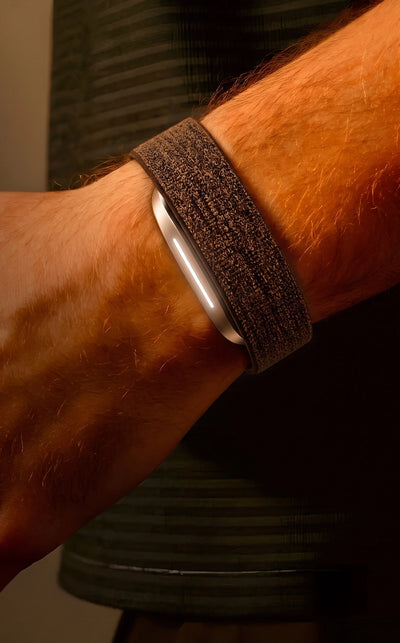 | Hume Band 2.0 The world’s first longevity band. Tracks biomarkers linked to biological aging. Free worldwide shipping. Free health tracking app. No subscription required. Band users gain an average of 2 years and 5 extra days of life from better habits |
The Hume Band 2.0: tracking what actually ages you
The Hume Band 2.0 is designed around the biomarkers that research consistently links to biological aging rather than just tracking daily activity. The distinction is meaningful in practice. A standard fitness tracker tells you how many steps you took and estimates your calories burned. The Band 2.0 tells you whether the habits you are building are moving your biological age in the right direction.
Hume reports that Band users gain an average of 2 years and 5 extra days of life from the habit changes they make based on their data. That figure reflects the compounding effect of small consistent improvements in sleep, recovery, cardiovascular fitness, and stress management over time. None of those improvements require dramatic lifestyle changes. They require knowing which specific habits to adjust and having a system that tells you whether the adjustments are working.
The Band connects to the same free Hume Health app as the Pod, which means people using both devices get a complete picture: what their body is made of through body composition scanning and how their daily habits are affecting their biological aging through continuous wearable tracking. The two data streams together produce a health profile that neither device provides alone.
How to use both together for the most complete health picture
The Hume Pod and Band 2.0 address different but complementary aspects of health. The Pod gives you a snapshot of body composition that updates each time you scan. The Band gives you continuous data on the biomarkers that drive aging and recovery across every hour of every day.
Used together, they answer the questions that most people are trying to answer when they think about their health: Am I losing fat or muscle? Is my body recovering well from training and stress? Are my daily habits moving my biological age in the right direction? Is the weight change I see on the scale reflecting actual body composition change or just water fluctuation?
The Pro.f AI health coach in the Hume app draws from both data sources to generate personalized recommendations that account for your specific body composition trends and biomarker patterns rather than a generic plan designed for an average person. This is the practical difference between having health data and having health intelligence.
Who benefits most from this approach to health tracking
People who have been exercising and eating well but cannot tell whether it is working because the scale is not moving. The most common experience among people who start strength training is that the scale stays flat or even goes up as muscle is built and fat is lost simultaneously. Without body composition data, this feels like failure. With it, it is clearly progress.
People on GLP-1 medications who need visibility into whether they are losing fat or lean mass during weight loss. Research shows that 25 to 39 percent of weight lost on GLP-1 medications comes from lean mass. Tracking body composition during treatment allows you and your care team to make protein intake and exercise adjustments that preserve muscle before the loss becomes significant.
People in their 40s and 50s who are noticing that weight management works differently than it did before. The hormonal changes of this decade affect both muscle retention and fat distribution in ways that the scale cannot explain. Body composition data makes those changes visible and trackable.
People who are already active and eating reasonably well but want to know whether their habits are actually affecting their biological age. The Band 2.0 is for this group specifically, people who are not starting from scratch but want data on whether what they are already doing is moving the longevity markers in the right direction.
Frequently asked questions
What is body composition and why does it matter more than weight?
Body composition refers to the proportion of fat, muscle, water, and bone in your body. Two people can weigh the same and have completely different health profiles depending on how that weight is distributed between fat and lean mass. Body composition gives you the context that weight alone cannot provide and is a more accurate indicator of metabolic health and disease risk.
How does the Hume Pod differ from a regular smart scale?
Most smart scales use a 4-electrode system that estimates upper body composition from lower body readings. The Hume Pod uses an 8-sensor system that measures each body segment directly, which produces more accurate segmental data and reduces the estimation error that affects single-measurement devices. It also measures 45 distinct health metrics rather than the 12 to 17 tracked by most smart scales.
What is longevity tracking?
Longevity tracking monitors the specific biomarkers that research associates with biological aging, including heart rate variability, resting heart rate, sleep quality, oxygen saturation, and recovery metrics. The goal is to give you data on whether your daily habits are affecting your biological age in a positive direction, which is different from tracking general fitness activity.
Is the Hume Pod HSA or FSA eligible?
Yes. The Hume Pod is HSA and FSA eligible, which means you can use pre-tax health savings funds toward the purchase. This can reduce the effective out-of-pocket cost by 25 to 35 percent depending on your tax bracket.
What does the free Hume Health app include?
The app includes the Pro.f AI health coach, which analyzes your body composition trends and biomarker data to generate personalized protocol recommendations. It also provides trend tracking, health scoring across multiple categories, and insights that translate raw numbers into actionable guidance. The app is free with every Hume Pod and Band purchase and available on iOS and Android.
Final thoughts
The scale has been the default health tracking tool for most people for their entire lives. It has the advantage of being simple, cheap, and familiar. It has the disadvantage of being an incomplete and frequently misleading indicator of health progress. A number that does not change can mean your habits are not working, or it can mean you are building muscle and losing fat simultaneously at exactly the same rate. Without body composition data, you cannot tell which is true.
The shift toward body composition and longevity tracking is not a trend. It reflects a genuine change in how physicians, researchers, and serious health practitioners think about what health measurement should include. The tools to do it at home, with clinical-grade accuracy and AI-guided interpretation, now exist and are accessible without clinical appointments or specialist referrals.
If you have been making decisions about your health based on one number, it is worth finding out what the other 44 have to say.
 | Shop Hume Health Hume Pod: 45 body composition metrics, clinical-grade accuracy, free AI app, HSA and FSA eligible. Hume Band 2.0: longevity biomarker tracking. Free worldwide shipping. 45-day returns. 1.2 million customers. Body composition. Longevity tracking. AI coaching. All in one place. |
Affiliate disclosure: This blog contains affiliate links. If you make a purchase through our link, we may earn a commission at no extra cost to you. We only recommend products we genuinely believe provide real value.
This blog is for informational purposes only and does not constitute medical advice. Consult your healthcare provider before making changes to your health management routine.